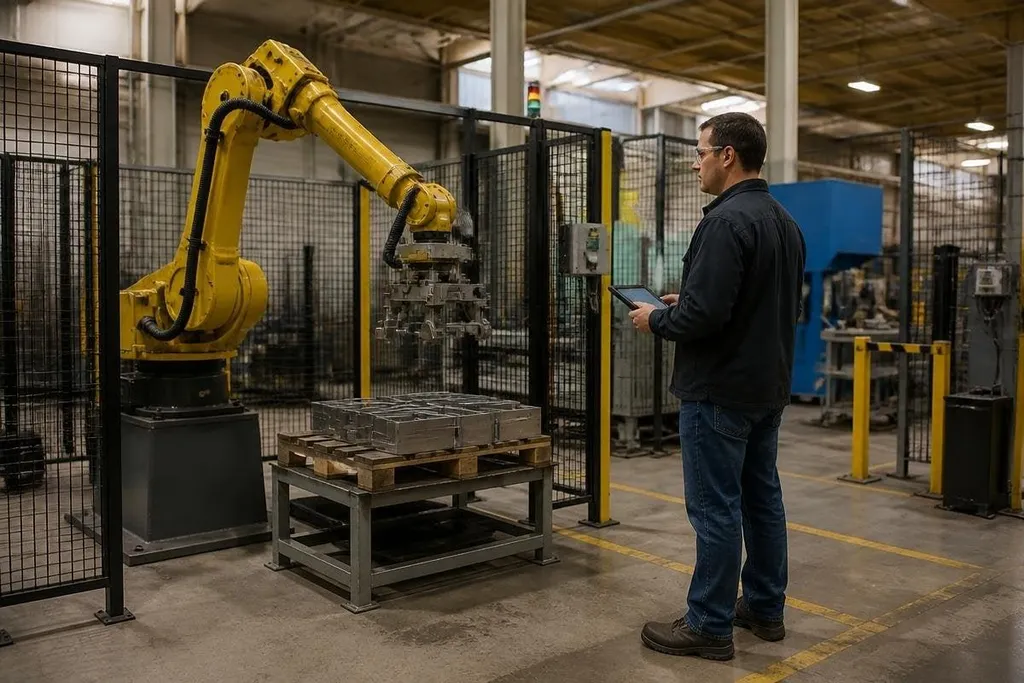
A robot can complete a task in a test cell and still create a serious hazard beside a worker. Safety standards turn that gap into checks for the robot, its controls, the work area, and the people using it.
- Standards set safety checks before deployment.
- Risk depends on the full work cell, not the robot alone.
- A certificate does not replace testing at the site.
A robot is only one part of the hazard
A robot arm may stop when its sensor detects a person. That does not answer every safety question. The gripper, carried load, floor space, access doors, nearby machines, and restart controls can all change the risk.
A slow robot can still hurt someone if it carries a sharp tool. A fast robot can be safe in a guarded cell when the guard prevents access during motion. The same arm may need different controls after a gripper, tool, software update, or production task changes.
That is why safety work starts with a risk assessment. The team lists each task, finds how a person could be hurt, estimates the risk, then chooses controls that reduce it.
The assessment must cover normal work, setup, cleaning, faults, maintenance, and recovery after a stop.
What the standards check
Different standards cover different parts of a robot system. ISO 10218 addresses industrial robot safety. ISO/TS 15066 covers collaborative robot applications, where people and robots may share a work area. ISO 13849 deals with safety-related parts of control systems, such as circuits that stop motion when a guard opens.
These documents do not turn a robot into a safe product by themselves. They give engineers a way to check whether protective measures work as planned, and they define terms that help buyers, builders, and inspectors discuss the same risk.
A safety-rated stop is one example. When a door opens or a protective scanner detects entry, the control system must stop the relevant motion and prevent an unsafe restart. The design also needs a clear way to reset the system, because a stop that causes confusion can lead to unsafe workarounds.
The details matter. A scanner may miss a person behind a fixed object. A guard may have a gap large enough for access. A reset button may sit inside the hazard area. Standards push the team to test those conditions instead of checking only the robot’s normal cycle.
Compliance is not the same as safe work
A supplier may state that a robot meets a standard. That statement can help with procurement, insurance, and inspection, but it does not prove that the finished work cell is safe for your task.
The buyer still needs records showing what was assessed, which protective devices were fitted, how stops were tested, and who may change the software or hardware. Training also matters because workers need to know how to start, stop, isolate, and recover the system.
Those records matter after deployment too, when a robot’s task or surroundings change. A dated Robot24.com safety report can put a machine’s guard, stop circuit, and test result beside the claim being made, giving an industry reader a concrete record before maintenance changes the work cell.
Maintenance creates another test point. A technician may remove a guard, bypass a sensor, or replace a tool during service. The work cell needs a safe isolation method, clear access rules, and a check before production starts again.
I’d reject any robot purchase that treats the safety file as paperwork finished after the machine arrives.
What to ask before deployment
Ask the supplier and your own safety team for answers that match the exact cell. A general brochure will not cover your floor plan or task.
- Name the task: Write down what the robot carries, cuts, presses, welds, or moves.
- Map human access: Mark every door, reach point, walkway, loading area, and maintenance entry.
- Test stop functions: Open guards, trigger scanners, and check that motion stops as designed.
- Check restart control: Confirm that a person outside the hazard area must reset the system.
- Record changes: Review the assessment after new software, tools, loads, or work steps arrive.
- Plan isolation: Give maintenance staff a tested way to remove power and stored energy.
What good safety work looks like
Good safety work is visible in the machine’s daily use. Workers can reach the stop controls, see when the system is safe to enter, and follow a known recovery method after a fault. The robot’s normal cycle is only one part of that test.
The strongest safety plan also has an owner. Someone checks the safeguards, keeps the records current, and stops production when a change creates a new hazard. That role cannot end with the supplier’s handover.
Robot safety standards matter because they turn broad caution into named checks. The open question for every deployment is more specific: can this exact cell protect people during production, maintenance, faults, and restart?